AILA
An independent study exploring how Adsnora would approach a modern beauty brand through market intelligence, creative strategy and performance testing.
infoIndependent study · not a client engagement
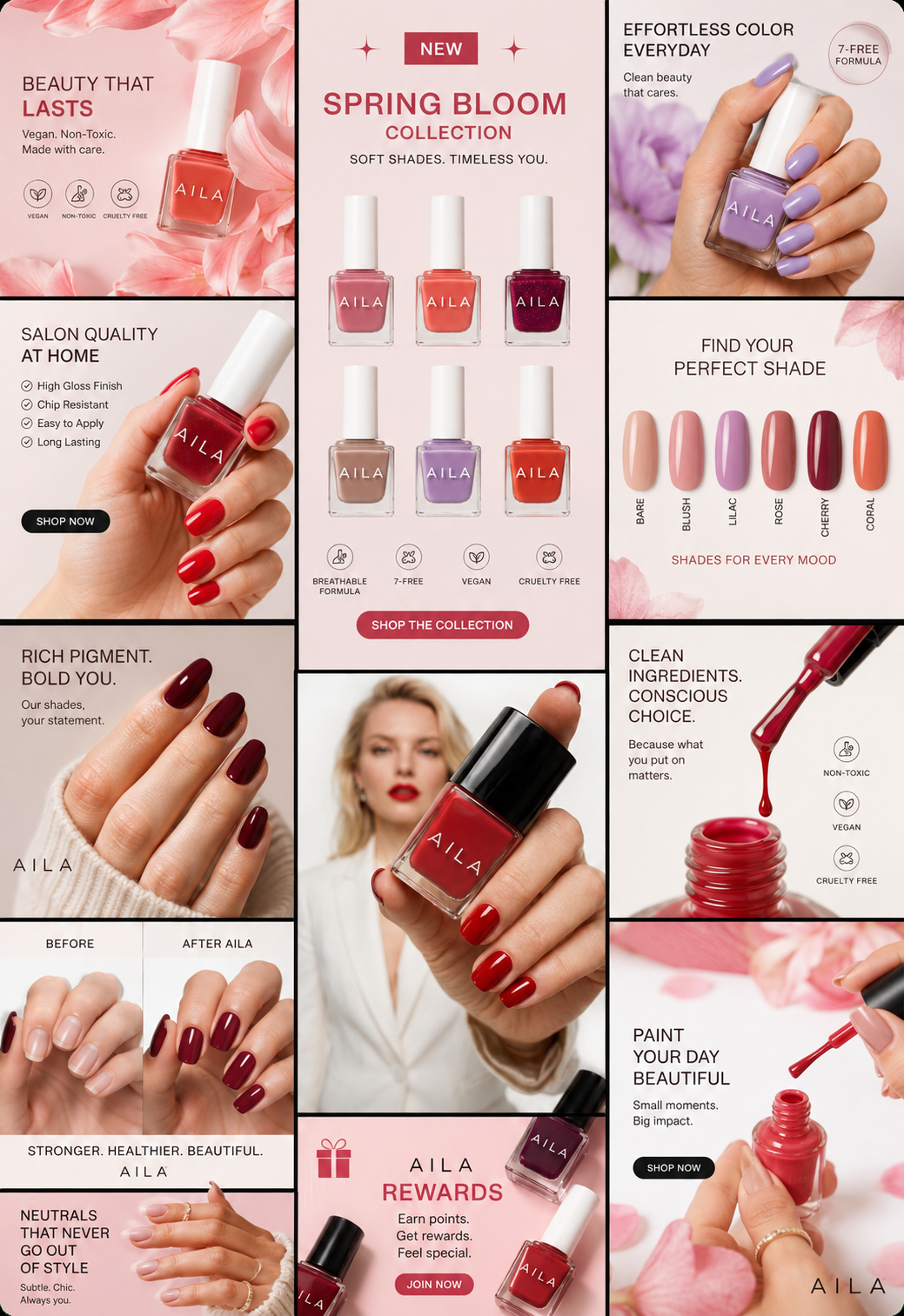
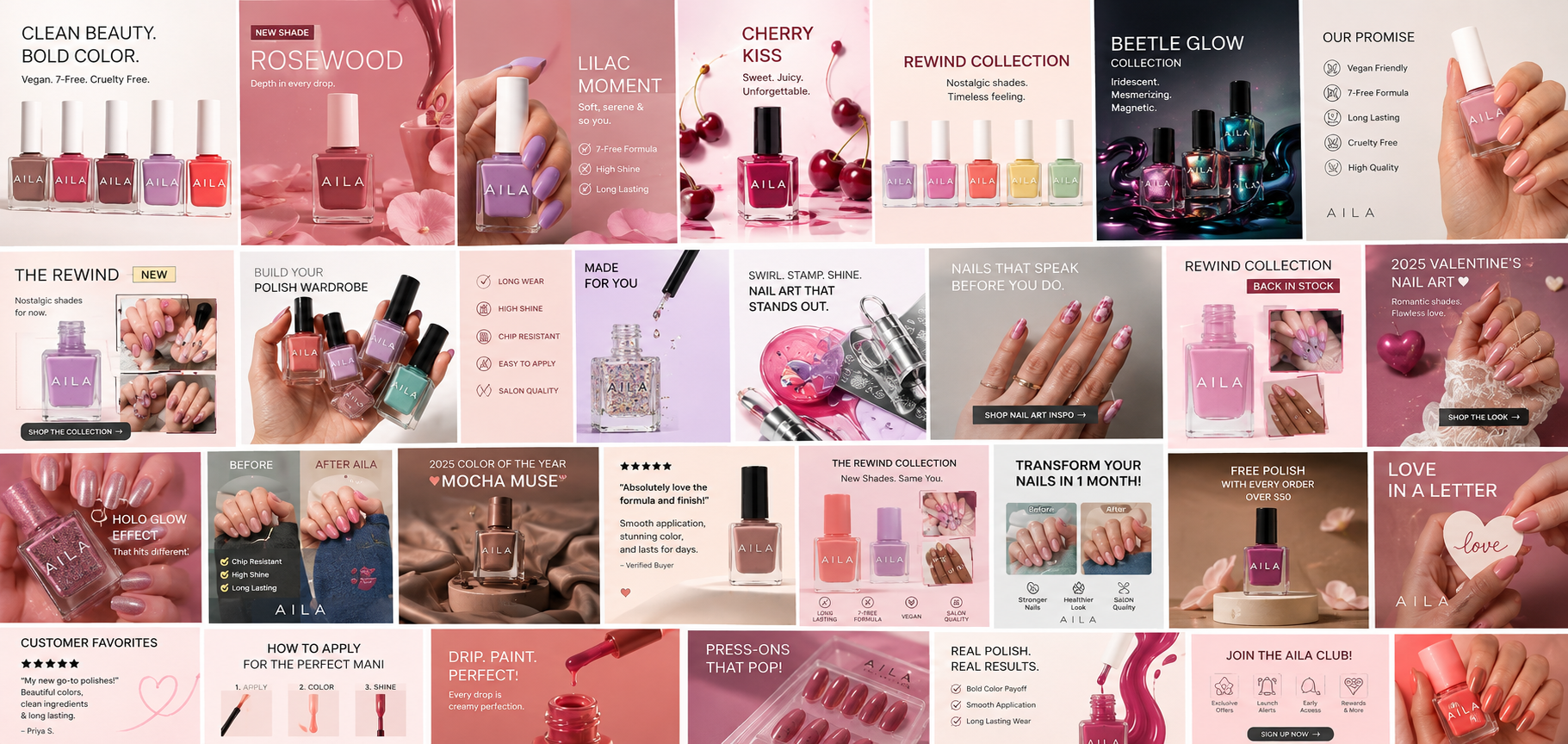
Clean-beauty nail brands have converged on a shared vocabulary. Vegan. Non-toxic. Cruelty-free. 7-free. Long-lasting. Salon quality. Every brand in the set makes the same promises, in the same order, over the same soft-focus product photography.
That convergence creates a specific commercial problem. When every brand communicates the same benefits, producing another beautiful ad isn't a strategy. It's a cost. You are paying auction prices to say what the customer has already heard from four other brands this week.
So before writing a single line of creative, we went looking for the gap between what the category says and what the customer actually asks for.
The claim set almost every brand in this category runs on. Read it twice and you have read the whole shelf.
Four signal layers, gathered independently from public sources. No client data, no ad-account access. Just the market talking.
Search figures throughout this study are Google Ads average monthly search volume, United States, English, pulled via DataForSEO in September 2026. Monthly peaks are cited from the trailing twelve months. Competition index is Google's own 0–100 auction-pressure score.
Both charts share one scale. Full width = 246,000 searches/month.
"7-free" appears as a trust badge on almost every clean-nail brand's creative. It draws 480 US searches a month. "Non-toxic nail polish" draws 27,100, fifty-six times more.
"Vegan nail polish" and "non toxic nail polish" both sit at 27,100 searches a month. But Google scores vegan at a competition index of 17 and non-toxic at 100. Same audience size, radically different cost to reach.
"Press on nails" pulls 201,000 searches a month at a $1.19 CPC. The category's substitute isn't a rival bottle. It's a format that promises the same outcome with less effort.
Two of the biggest terms in this category barely exist for most of the year, then arrive all at once. A flat, always-on creative calendar cannot catch this.
Five territories, each drawn from a signal in the data rather than from taste. Each one reads: what the market showed us, what it suggests the customer wants, and what we would therefore make.
"Show me what I could look like." Discovery comes before brand preference; people shop a colour, then find out who makes it.
Lead with the shade, not the bottle. Named colours, shade-finder formats, wearer-first imagery. The cheapest attention in the category sits here.
Demand arrives in waves tied to a date or a season, not to a product launch calendar.
A creative calendar built around the market's peaks. Assets ready four to six weeks ahead of each spike rather than in the middle of it.
Colour is a statement about the wearer, not a specification of the product.
Sell the signal the manicure sends. This is the least-crowded territory in the set precisely because the category is busy talking about formulas.
"I want the salon result without the salon trip, and without repainting in three days."
Position against the substitute, not the shelf. Application ease and wear time answer the exact objection driving people to press-ons.
Longevity is the most-searched functional benefit, but it is also the most-claimed, so assertion alone is worthless.
Demonstrate the claim instead of stating it. Wear tests, day-count formats, before-and-after. Use the customer's word ("lasts"), not the trade's ("chip resistant").
This is the part most creative decks skip. A concept is only defensible if you can name the evidence that produced it.
"Nail inspo" draws 246,000 monthly searches at a $0.10 CPC, nine times the demand of "vegan nail polish" at a fraction of the cost.
People shop for a look before they shop for a brand. Discovery is the top of this funnel, not credentials.
Make the shade the hero and give it a name worth remembering.
"Find your perfect shade": a six-shade discovery strip. Named colours: Bare, Blush, Lilac, Rose, Cherry, Coral.
"7-free" draws 480 searches a month, yet it is a lead badge across the category's creative.
It is a reassurance mark, not an acquisition hook. Useful once someone is already considering; wasted as an opening line.
Demote credentials from headline to footer. Keep them visible, stop paying to lead with them.
Shade-led hero with vegan / 7-free / cruelty-free as small trust marks at the base of the frame.
"Valentines day nails" runs 1,900 in June and 823,000 in January. "Fall nail colors" swings 1,300 to 368,000.
The category's demand is event-shaped. Evergreen creative arrives permanently late to its own market.
Build seasonal capsules that ship ahead of the spike, not during it.
Valentine's nail-art edit; Spring Bloom capsule; a Colour-of-the-Year trend piece.
"Chrome nails" 60,500 and "glazed donut nails" 14,800. Finish-led trends with sustained, not spiky, demand.
Finish is a trend axis the polish category under-serves while chasing colour alone.
Treat finish as its own product story.
"Beetle Glow" iridescent collection; "Holo glow effect. That hits different."
Concepts developed by Adsnora for this study. Each one belongs to a territory, and each territory exists to test a specific hypothesis about what moves this market.

Named shades and capsule drops. Tests whether colour-led entry beats brand-led entry at the top of the funnel.
"Nails that speak before you do." Tests whether the category's least-used territory is under-used or simply ineffective.
Before / after, wear tests, verified reviews. Tests whether demonstration outperforms assertion on the longevity claim.
Gloss, wear, application. The category default, included as the control rather than the lead.
Colour of the year, chrome, holo, seasonal art. Tests whether trend relevance can be converted at acquisition cost.
Application technique, wardrobe building. Tests whether reducing perceived effort widens the buyer set.
Vegan, 7-free, cruelty-free. Deliberately demoted to a supporting role to test the cost of leading with it.
Threshold gifts, rewards, club. Tests economics rather than message: what a repeat buyer is worth to acquire.
Choosing a colour is the genuinely hard part of the purchase. Most category advertising skips it and sells the formula instead.
Shades for every mood
Rather than selling the bottle, this concept sells the moment of finding a signature shade. Six named colours laid out as a decision, not a catalogue. The ad does the job the product page usually has to.
It maps to the largest and cheapest demand pool we found. If shade-led entry lowers cost per click without degrading conversion, it changes the whole prospecting structure.
A manicure is a social signal. The category almost never says this out loud.
Nails that speak before you do
No product claim in the headline at all. The line sells the wearer's self-image and lets the polish be the means rather than the subject. That is the sharpest available break from a category which opens with ingredients.
This is the clearest whitespace in the set. It is also the riskiest concept here, which is exactly why it needs a test rather than an opinion.
Everyone claims long wear, so the claim has stopped carrying information. The buyer has been disappointed before.
Before → after, one month
Convert the most-claimed benefit into the one thing competitors aren't supplying: evidence. A visible time-bound demonstration answers the objection instead of restating the promise.
"Long lasting" carries 14,800 monthly searches, the strongest functional demand in the set. Whoever proves it rather than claims it should win that intent cheaply.
Trend participation. Chrome and holo finishes carry sustained search demand independent of any brand.
Iridescent. Mesmerizing. Magnetic.
Treat finish as the product story rather than an attribute. The concept borrows the visual language of a trend the customer is already searching for, which lets the ad arrive as relevant rather than interruptive.
Chrome sustains 60,500 monthly searches without seasonal collapse, which is unusual in this category. If finish-led creative converts, it is a year-round angle rather than a spike play.
Not what worked, because nothing here has run. This is the structure we would take into a live account, designed so that every result isolates one variable.
The goal isn't to find the prettiest ad. It's to identify which combination of customer motivation, message and execution creates the strongest commercial response, then to understand why, so the next round starts ahead of this one.
Performance data feeds the next creative decision. Every test returns another signal about the market, the customer and the message, and that signal re-enters the intelligence layer. The loop is the product. The ads are just where it touches the market.
This study has no performance data because there is no campaign behind it. These are the metrics we would hold ourselves to from day one of an engagement.
Three-second views over impressions. Tells us whether the hook earns the first moment.
Scroll depth, shade interaction, add-to-cart rate. Where the message and the page stop agreeing.
Return measured against contribution margin, not revenue, and against a defined attribution window.
Which territory won, creative fatigue curves, and shade-level demand feeding back into merchandising.
We'll run this analysis on your category and show you what we find, before you spend anything.